One Bottleneck Offer Strategy: How I’d Start Over (As an Affiliate Marketer) to Make Money Online Faster
One Bottleneck Offer Strategy: How I’d Start Over (As an Affiliate Marketer) to Make Money Online Faster
The first time I tried to “make money online,” I did what most of us do. I built a whole plan in my head, watched hours of videos, saved a dozen swipe files, tweaked my profile… and then wondered why nothing moved.
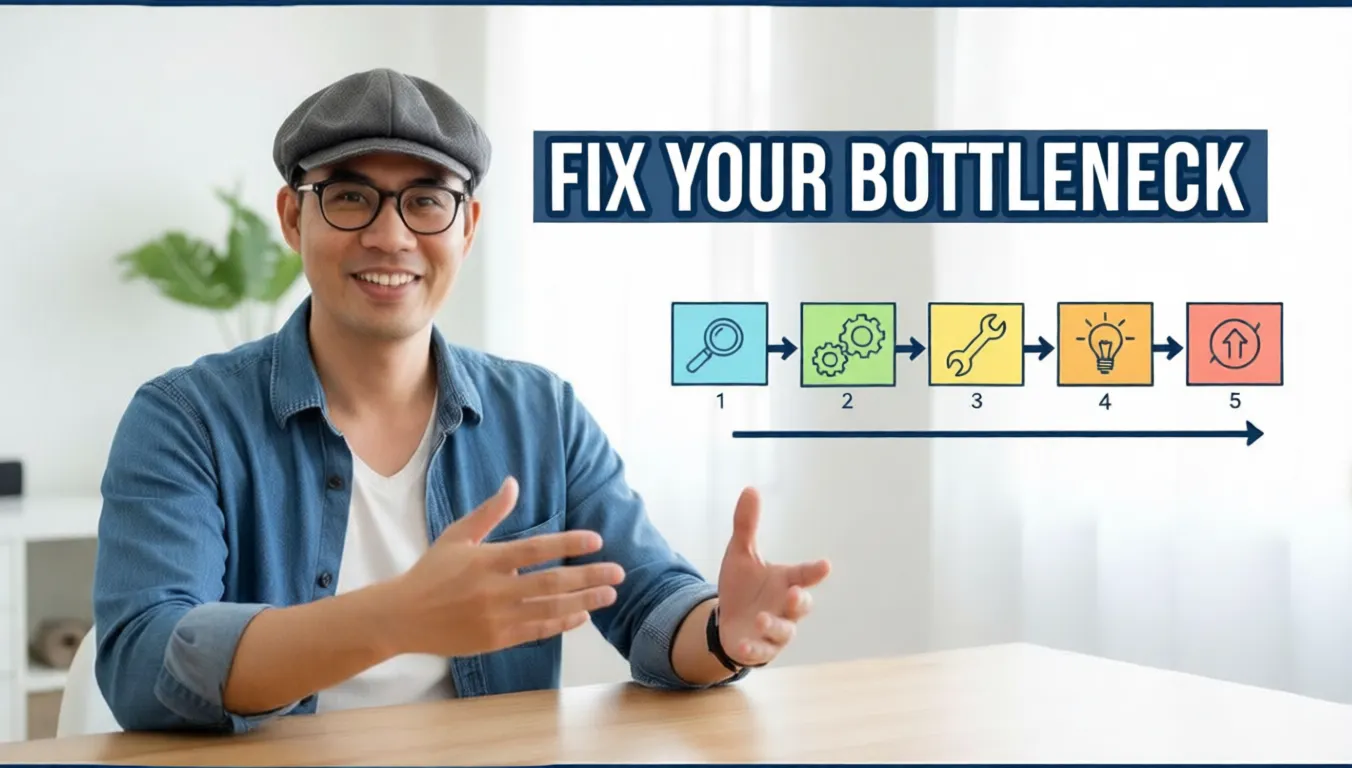
I still remember the moment it clicked. I was sitting there with a “perfect” setup and zero momentum, and I realized I didn’t have a motivation problem. I had a bottleneck.
One stuck step in my process was blocking everything downstream. Fix that, and the rest gets easier.
That’s the heart of the One Bottleneck Offer Strategy. It’s not about doing more. It’s about finding the single bottleneck that is slowing results and designing an offer that removes it. I’ll keep this grounded in affiliate marketing and business opportunity seekers, because that’s my world as a solopreneur.
(And yes, I still have to remind myself of this lesson when I get tempted by shiny new tactics.)
Why this matters more in 2026 and beyond
Two big shifts have made “random effort” less reliable.
First, Google’s AI summaries have changed the click game. Pew Research found that when an AI summary appears, users click links less often. In their analysis, people clicked traditional results less frequently when AI summaries were present. Pew Research Center
Second, TikTok has been in the news again, with major reporting about a deal involving TikTok’s U.S. operations and American investors. AP News
I’m not bringing that up to be dramatic. I’m bringing it up because it’s a good reminder: platform reach is not something you fully control. Your strategy and your process are.
So if you’re new, I’d rather help you build an effective strategy that works even when algorithms wobble.
What the one bottleneck offer strategy is
The one bottleneck offer strategy is a focused strategy where you:
- Identify the biggest bottleneck stopping you from getting paid
- Create an offer that removes that bottleneck quickly
- Repeat a simple process long enough to learn what’s actually happening
You are not fixing everything. You are fixing the next stuck point.
That’s it.
The most common bottlenecks I see for beginners
When you’re starting, you’ll run into common bottlenecks like these:
- Not enough conversations with potential customers
- You get replies, but you do not know what to say next
- Your offer is unclear, so people stall
- You avoid follow-ups, so the deal dies quietly
- You do too many unnecessary steps and burn out
- You spend too much time on repetitive tasks instead of money-making actions
Any one of those can become a business bottleneck inside your early business process.
And here’s the part that’s oddly comforting: you can be doing a lot “right” and still be blocked by one constraint. Remove that constraint, and the whole system breathes.
A 10-minute bottleneck analysis (no spreadsheet required)
I’m a fan of simple tools that you actually use. Here’s a quick bottleneck analysis you can do today.
Map the entire process
Write your entire process like this:
Attention → Conversation → Offer → Purchase → Result
Now ask:
- Where does the process slow down?
- Where do people drop off?
- What step feels “sticky” for you?
That sticky point is the bottleneck.
You might notice potential bottlenecks in more than one place. Pick one. This strategy works because of focus.
A quick personal lesson
Early on, I kept trying to “optimize my funnel” when my real bottleneck was that I wasn’t starting enough conversations. I was polishing step 4 when I was barely doing step 2. Once I fixed that, everything changed.
The constraint behind the bottleneck
Most bottlenecks come from one main constraint. In beginner affiliate marketing, it’s often one of these:
- Clarity constraint: “I don’t get what you do”
- Trust constraint: “Will this work for me?”
- Effort constraint: “This looks complicated”
- Time constraint: “I don’t have time”
- Consistency constraint: “I keep stopping and restarting”
A quote that fits this perfectly comes from James Clear: “You do not rise to the level of your goals. You fall to the level of your systems.” James Clear
In our world, “systems” usually means your daily workflow and repeatable process.
How to build an offer that removes the bottleneck
If you’re new, your offer should do one job: remove the process bottleneck that stops the next step.
Here’s the filter I use when I’m shaping an offer:
- Does it reduce risk?
- Does it reduce effort?
- Does it reduce time to a first win?
If yes, you’re building something people can say yes to without a long debate. That’s strategy and efficiency working together.
Example 1: Lead generation bottleneck (the “not enough conversations” problem)
This is the most frequent common bottleneck I see. If you are not having conversations, your lead generation is the bottleneck.
When I was starting, I used to tell myself “I just need more followers.” But the real issue was that my next step was vague. People didn’t know what to do.
What I’d do instead
Create a tiny “starter win” offer that makes it easy to raise a hand.
Here are a few affiliate-friendly options:
- “Want my 3-step beginner plan for getting started?”
- “Tell me your goal and I’ll point you to the best first step.”
- “Want the checklist I used to get my first consistent leads?”
This is how you attract qualified leads instead of random curiosity.
(Aside: you’ll be surprised how often a simple invitation beats a clever pitch.)
Example 2: Sales process bottleneck (people reply, but do not buy)
If you get DMs but not purchases, your sales process is likely the bottleneck. The sales cycle gets longer because the buyer has too many unanswered questions, or too many decisions.
I’ve been there. I once ran what I thought was a “helpful” conversation that lasted 17 messages and ended with “Thanks, I’ll think about it.” That was on me. My process wasn’t clear.
The beginner fix
Make the offer ridiculously clear:
- Who it’s for
- What outcome it helps
- What happens first
- What the first win looks like
This is basic process optimization. You’re reducing confusion, which reduces inefficiency, which improves efficiency.
If you ever build with a partner or a small sales team (even one setter helping you book calls), keep the handoff simple: one sentence about the person’s goal, one sentence about the obstacle, and one next step. Clean process, cleaner results.
Example 3: Delivery bottleneck (sales happen, but results do not stick)
Some beginners actually do sell, but they cannot keep momentum because delivery is messy. That creates a quiet bottleneck: fewer testimonials, fewer referrals, and lower customer satisfaction.
This is where people think they need more marketing, but what they really need is better follow-through.
What helped me as a solopreneur
I created a simple checklist for what happens after someone buys. It wasn’t fancy. It was basic project management.
- Day 1: welcome message + first action
- Day 3: check-in + troubleshooting
- Day 7: progress review + next step
That one change reduced my repetitive tasks because I stopped retyping the same directions. It also made my process feel more professional without adding complexity.
This is the part nobody wants to hear, but it’s true: your business operations is part of your marketing. Results create proof. Proof makes the next sale easier. That’s a compounding strategy.
The daily workflow I recommend (for ordinary people with limited time)
Let’s make this practical. If you’re working a job, raising a family, or just trying to keep your head above water, you need a simple workflow.
Here’s a beginner-friendly daily process:
- 10 meaningful comments in your niche
- 1 post that speaks to one problem
That’s it. One task at a time.
Now, rhetorical question time: What would happen if you did that for 7 days without changing the strategy mid-week?
Most beginners never find out because they keep switching.
Once your posts start to get more traction, you can use engagment focused posts (asking people to DM or comment). Using this strategy, it's easier to have 1:1 conversations.
How to spot existing bottlenecks vs short term bottlenecks
Not every “bad week” means your whole plan is broken.
- Short term bottlenecks are temporary. Travel, sickness, holidays, a stressful work week.
- Existing bottlenecks are the repeat offenders. You avoid follow-up, you keep changing offers, you never make a clear ask.
Here’s a question I ask myself when I feel stuck: What is the one step I keep avoiding? That step is often the bottleneck.
What to do about inefficient processes and inefficient workflows
Beginners accidentally build inefficient processes all the time. They bounce platforms, rewrite messages daily, and add more steps because it feels productive.
But extra steps often create inefficient workflows. More moving parts usually means more friction.
A smarter strategy is to optimize processes you already have:
- Keep one offer for a full week
- Use one DM opener for a full week
- Use one CTA for a full week
- Remove extra links and steps
That improves efficiency because you spend less time reinventing and more time executing.
Operational bottlenecks (when you start gaining traction)
When you begin to get sales, new operational bottlenecks show up. That might look like slower onboarding, unclear delivery, or inconsistent support.
This is where a solopreneur wins by simplifying. Don’t add complexity. Tighten the process.
Continuous improvement (the part that makes this sustainable)
This is the long game, and it’s the part I’ve personally had to learn the hard way.
You do not need a new identity. You need continuous improvement.
Here’s the loop:
- Identify the bottleneck
- Adjust one small piece of the process
- Run the same strategy for 7 days
- Keep what works and drop what doesn’t
That is how you build sustainable growth without burning out.