AI Agent Swarn Review: My Honest Take
AI Agent Swarn Review: My Honest Take
I still remember the first time I tried to “automate” my affiliate workflow.
Nothing fancy. A few checklists, some recycled email templates, and a promise to myself that I wouldn’t keep rewriting the same angles every time a new offer popped up.
Two weeks later, I was still doing everything manually, plus I now had broken automations to fix.
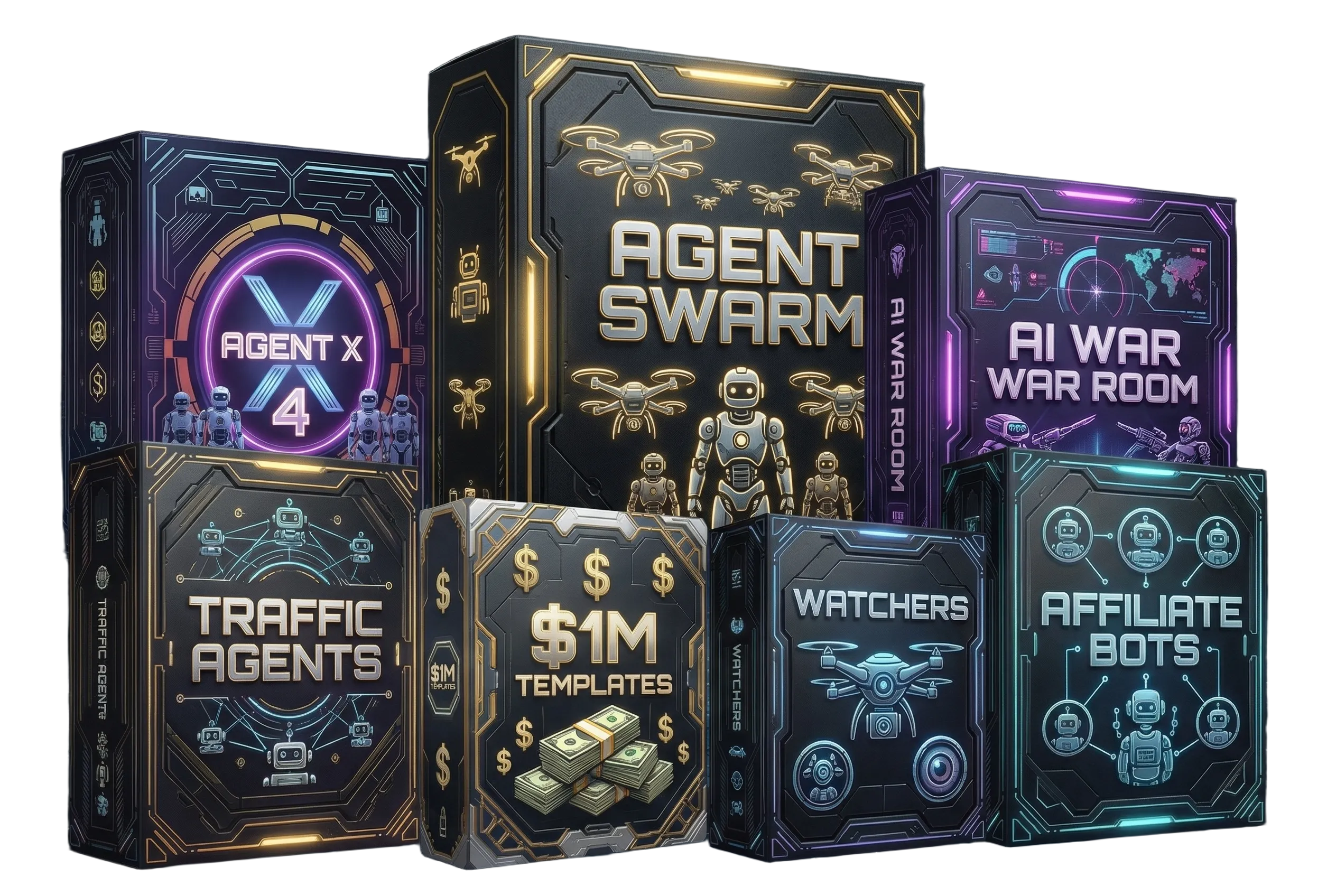
That’s why I paid attention when I saw the Agent Swarm pitch, especially with Chris X as the creator (remember Adwords Miracles, Affiliate Profit X, and Day Job Killer? - popular stuff back in 2006-2009) .
Chris frames this as an AI team that can run work without you hovering over every step. The headline is obviously aggressive, but the core idea is worth looking at with clear eyes.
So here’s my colleague-to-colleague breakdown. What it is, what it’s trying to solve, where it can help, and where you should keep your guard up.
What “Agent Swarm” really means
It’s not one AI, it’s a team
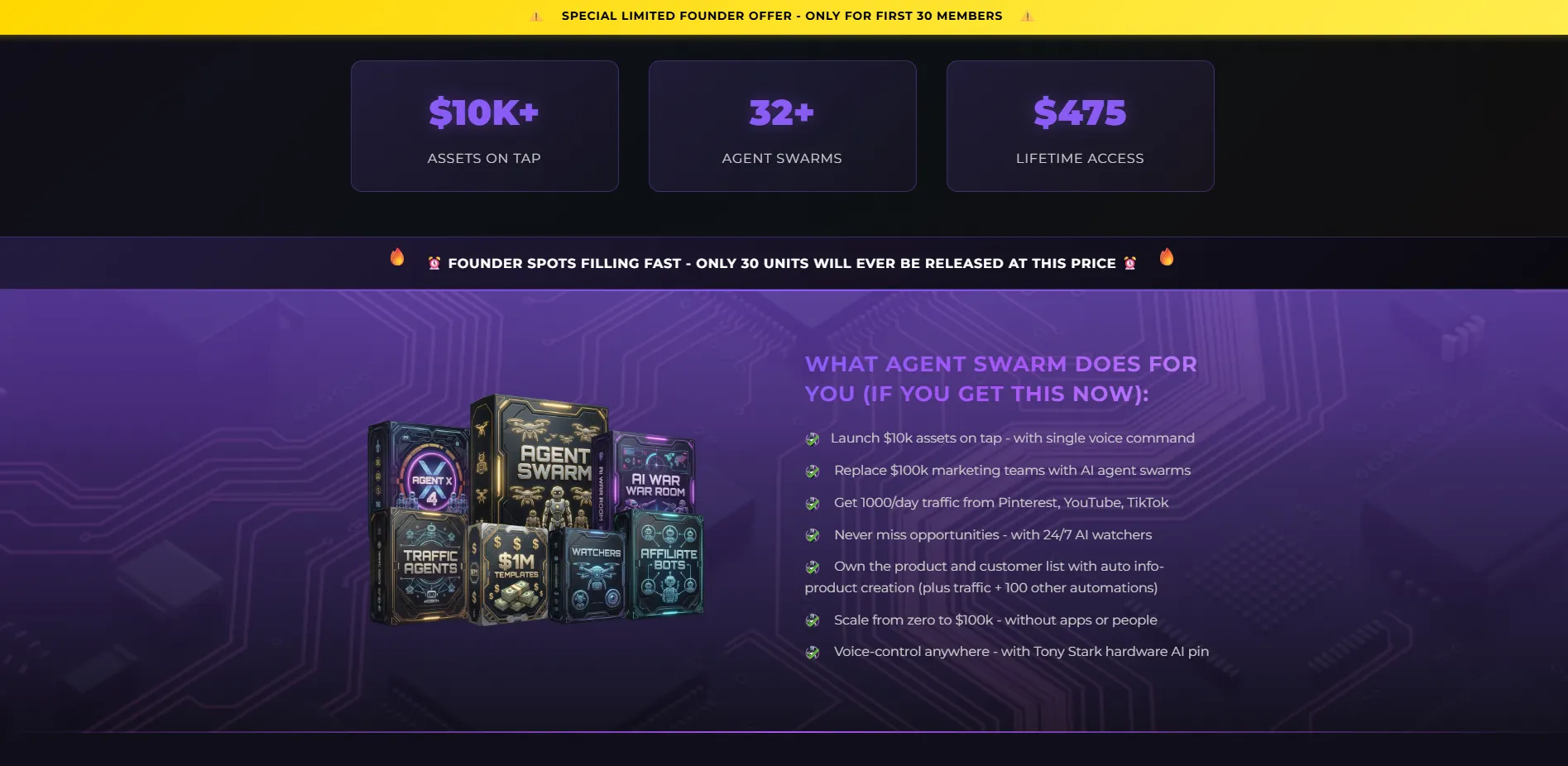
The simplest way to explain it is this: an Agent Swarm is a coordinated team of AIs, not a single chatbot.
They’re meant to work together as a group, sharing a workspace and tools so they behave more like a small team than a solo assistant. If you’ve ever wished you could split work between a researcher, a copywriter, a designer, and a QA person, you get the appeal.
(And yes, I’ve tried to do this manually by juggling multiple tabs and prompts. It works, but it’s clunky.)
It runs through step-by-step tasks that can repeat until done
A big concept in the training is “steps” that can run in a loop until a step finishes.
That’s a meaningful shift from typical AI usage, where you prompt once, get one output, and then you become the project manager again. A swarm-style workflow is trying to remove that constant babysitting.
It’s meant to chain multiple skills into one workflow
The promise is orchestration. You give a high-level objective, and the system breaks it down and assigns work across the “agents.”
In keyword terms, think agent orchestration, AI workflow automation, and a multi-agent AI system that can handle different parts of the same project. If you’ve only used basic AI writing tools, this is aiming to be the next layer up.
Why “agents” are suddenly everywhere (and why that matters here)
If you’ve been watching the AI space, you’ve seen the shift.
Big research groups and businesses are talking about agents as systems that do real work, not just generate text. That lines up with what people like Ethan Mollick have been writing and teaching: we’re moving into a phase where these systems can complete tasks in a more practical way.
But there’s also a reality check happening in public.
There was a widely shared recent story about an AI agent running a small business-style task and getting manipulated into making dumb decisions. It was funny and painful at the same time. It’s a reminder that autonomy without guardrails can go sideways fast.
So when I review something like this, I’m asking:
- Can it actually produce assets we can use?
- Can it operate safely in the messy reality of marketing?
- Will it save time, or just create new problems?
Because you and I both know the real enemy is wasted time.
What Chris X is really selling (beneath the big headline)
The “$590 per minute” framing is attention-grabbing. I’m not here to argue the number.
I’m here to translate the promise into marketer terms: build a system that can produce assets, variants, and campaign pieces fast enough that you can test more and ship more without burning out.
If you’ve ever launched an offer and thought, “I need a review page, an email sequence, a follow-up angle, a short-form script, and I need it by tomorrow,” you know why this lands.
I’ve been there.
I’ve also been on the other side, where I rushed out a page that technically looked fine, but didn’t convert because the message wasn’t tight. Tools don’t fix that. You do.
A swarm can help with production. It doesn’t automatically fix positioning, offer match, or trust.
Real-life examples: how I’d actually use a swarm (and where it can break)
I’m going to give you three practical examples based on how I run things as a solopreneur at infoSpike.com.
Not fantasy scenarios. Real workflows with wins and friction.
Example 1: Launch-week content stack for an affiliate offer
When I promote something new, I typically need:
- A review page
- A bonus page
- Email angles
- Short-form scripts
- A follow-up sequence for non-buyers
This is where AI task automation starts to feel like oxygen. A swarm concept suggests you can start with one high-level prompt and produce a coordinated batch of assets across channels.
Here’s a personal truth: when I’m tired, I default to safe copy. It becomes “fine” instead of sharp. When I can generate multiple angles quickly, I can pick the strongest and then do the human pass that adds teeth and clarity.
The challenge is quality control. The swarm might produce 10 drafts, but if 7 are bland, you still need judgment to pick the 3 that actually deserve your list.
Ask yourself: do you want more output, or better output?
Example 2: Website buildout with creatives (fast, but watch the glue)
The training talks about producing a website plus supporting creatives like logos and banners.
I’ve built enough small funnels to know the pain point here. The page might be “done,” but the visuals lag behind. Then you duct-tape something together in Canva at midnight. I’ve done that more times than I want to admit.
A swarm workflow could be useful if it reliably creates:
- Page structure
- Copy sections
- Creative prompts for visuals
- Basic brand consistency
This can be a real win for speed.
The challenge is cohesion. You can end up with a logo that feels playful, a banner that feels corporate, and copy that feels like it belongs to a third brand. That mismatch silently kills conversions.
So even if you use automated creative generation, plan on one human “brand pass” to tighten the vibe.
Example 3: Iteration loop for ads and email (the part most people never do)
Most people don’t fail because they can’t write.
They fail because they don’t iterate.
I’ve seen it in my own work. When I commit to testing, my numbers improve. When I get lazy and stop, everything flatlines. It’s not glamorous, but it’s real.
A swarm can help by producing new variants weekly, so you can test:
- Subject lines
- Hooks
- CTAs
- Lead magnet angles
- Retargeting copy
That supports consistency, which is the part most solopreneurs struggle with.
The challenge is the same as always: output can become noise. Without a filter, you end up with a folder full of “almost okay” copy that never gets deployed.
So you still need a simple rule like: test two variants, pick a winner, then repeat.
Practical advice: how I’d test this without wasting a week
If you decide to try Agent Swarm, run it like a controlled experiment.
- Pick one workflow, not everything at once.
- Start with email, or short-form scripts, or a review page.
- Define “done” clearly.
- “A 7-email sequence with 2 angles, 1 follow-up, and 1 re-engagement email” is clear. “Help me promote this” is not.
- Run a small batch, then measure a real metric.
- Clicks, replies, opt-ins, or sales. Something that matters.
- Keep a human review step.
- Even if it’s quick. You’re protecting your brand voice and your trust.
- Iterate once before you decide.
- The first batch is rarely perfect. The second batch tells you whether the system actually learns your preferences.
This is how I evaluate any tool now, because I’ve made the mistake of falling in love with features instead of results.
(And yes, I’ve ignored my own advice before. It always costs me.)
What I like most about the concept
It matches where the market is heading.
People like Andrew Ng have talked for years about AI’s real value showing up when you build workflows around tasks, not when you treat it as a novelty. A swarm is basically that idea applied to a set of coordinated workers.
Also, large organizations are actively experimenting with agentic systems. That’s not hype, it’s where budgets are moving.
So even if you never use this specific product, the broader model matters: coordinated AI agents, working through agent-based automation, producing drafts and assets you can refine and deploy.
That’s a useful mental model for 2026 and beyond.
What I’d be cautious about (especially if you’re marketing to cold traffic)
1) Hype math vs business math
Big income claims are not a strategy.
Business math is still the same:
- Offer selection
- Audience match
- Trust building
- Tracking
- Follow-up
A swarm can support production. It does not replace fundamentals.
2) Autonomy can be risky without guardrails
Autonomous systems can make confident mistakes.
And marketing is an environment where people will try to exploit loopholes. If you set anything to run unsupervised, make sure mistakes are reversible. Keep the system focused on creating drafts and assets, not making irreversible decisions.
3) You still need a taste filter
This is personal, but it’s important.
Every time I’ve tried to scale content too fast, I’ve had to stop and ask, “Does this sound like me?” If it doesn’t, my list can feel it.
So if you use a AI agent framework or anything close, plan to edit. You’ll move faster, but you still steer.
Let me ask you a direct question: if your brand voice matters, are you willing to do that steering?
Who this is for (and who should pass)
You’ll probably like it if you:
- Build funnels, reviews, bonuses, or content assets repeatedly
- Want faster production without hiring a full team
- Enjoy systems, workflows, and testing
- Need help moving from idea to execution
You should probably pass if you:
- Want push button money with no thinking
- Hate reviewing and polishing drafts
- Don’t have a clear offer and audience yet
Here’s a simple gut-check: do you want a helper that produces drafts, or do you want a replacement for decision-making?
If it’s the second one, you’ll be disappointed.
Final thoughts (and what I’d do next)
This AI Agent Swarn Review comes down to one core idea: speed plus structure.
If Agent Swarm helps you produce cohesive drafts across channels, and it reduces the mental load of planning and execution, it can be a useful tool in a solopreneur stack. If it creates a mess you still have to untangle, it’s just another shiny object.
If you’re considering it, I’d start with one simple workflow:
- Have it generate a 7-email sequence
- Then generate 10 short-form scripts
- Then generate a single review page outline
- You review, tighten, and deploy
That’s it. Small test, real metrics, quick decision.
Now I want to turn it back to you.
Where do you feel stuck right now, content output or conversion? And if you had a reliable “AI team,” what would you hand off first: research, copy, creatives, or follow-up?
If you reply with those two answers, I’ll suggest a clean, practical workflow you can run this week, written in your voice, and aligned with how affiliate campaigns actually get traction.

A quick note before you decide
No matter how exciting any tool sounds, it’s smart to slow down and do your own research, compare alternatives, and make sure it fits your workflow and risk tolerance before you commit.
If you're looking for a way to use leverage to grow your income faster than ever before, there's a tool some creators talk about quietly. It's called AIFinity, and it's changing how people create, launch, and sell digital products overnight. Check out AIFinity - it's free.